What Is a Feis?
A feis (pronounced fesh; plural feiseanna, fesh-AH-nuh) is, in modern usage, a one-day Irish dance competition held in a hired hall. The word is very much older than that, and the gap between its two meanings is the most interesting thing about it.
The word before the competition
In early Ireland the great public assembly was the óenach (later aonach, roughly AY-nakh) — a gathering that combined law-giving, trade, athletics, horse racing, music and recitation, held at a fixed place on a fixed date under the authority of a king. The best documented of these were the assembly at Tailtiu, in what is now County Meath, and the Feis Temhrach, the Feast or Assembly of Tara. These were not festivals in the modern sense of an entertainment. They were the machinery by which a scattered rural society did its collective business once a year.
What the assemblies did contain, alongside the law and the livestock, was performance: poets reciting genealogy and praise, musicians, storytellers, and contests of skill. That association — a fixed calendar date, a crowd drawn from a wide area, and competition in cultural accomplishment — is what survived the institution itself. When the Irish cultural revival of the late nineteenth century went looking for a native word for a competitive cultural festival, feis was sitting there ready to be reused.
What the revival made of it
The revival-era feis was deliberately broad. It was a competition in Irish accomplishments generally: singing, instrumental music, recitation, oratory, essay writing, drama, art, the Irish language itself, and dancing. Many still are, at least on paper. It is a common convention that an event is only properly a feis if it includes at least one discipline besides dance, and larger events often keep a music or singing competition running in a side room for exactly that reason.
In practice the dancing has taken over almost completely. A twenty-first century feis in North America or Britain is, to any observer, a dance competition with a small vestigial tail of other categories. The name has stayed put while the content narrowed — which is why the word confuses people who first meet it in a music context and then find themselves in a hall full of dancers.
What actually happens on the day
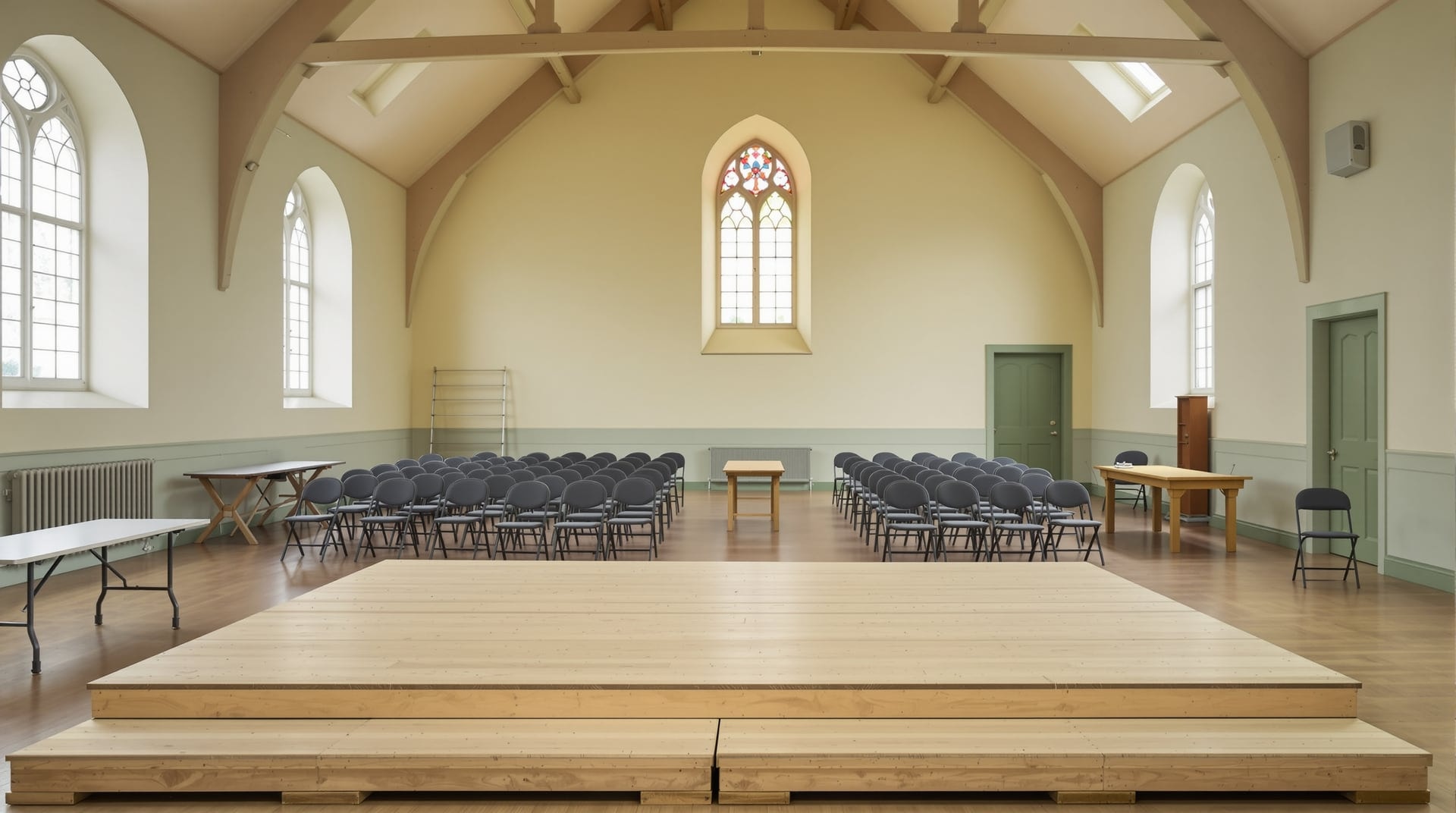
A feis is a long day and a mostly administrative one. Competitions are divided first by grade and then by age, so a single event may run several hundred separate competitions across a morning and afternoon. Dancers appear in small groups on a raised platform, usually two or three at a time, dance one solo dance each, and leave. An adjudicator sits at a table below the stage, marks each performance, and passes the sheets to a tabulator; results are posted through the day rather than announced at the end.
Two practical details surprise newcomers. The first is that dancers change shoes between rounds — soft shoes for the reel and slip jig, hard shoes for the treble jig and hornpipe — so the sound of the hall alternates between near-silence and a hard rhythmic clatter. The second is the accompanist: a single musician, usually on accordion or fiddle, playing the same handful of tunes at prescribed speeds for hours, adjusting tempo for each competition rather than each dancer.
Everything else is queueing. Numbers are pinned on, competitions are called over a public address system, families camp along the walls, and the shoes come on and off. It is a folk festival that has been reorganised into a timetable.
Feiseanna, and the ladder above them
A single feis is a local event. Its function within the wider structure is to move dancers up the grades: win enough at one level and you are obliged to move to the next, so a dancer's grade is a record of past results rather than a self-assessment.
Above the local feis sits the Oireachtas (roughly uh-RAKH-tus), a word that simply means an assembly or gathering and is used in Ireland for the national parliament as well. In the dance world it means a regional championship. Entry is normally by teacher's decision rather than open registration, dancers compete within their own geographic region, and the field is divided by age alone rather than by grade — so a regional championship gathers the strongest dancers of a given age from a very wide area into one competition.
At a regional championship, dancers perform a soft-shoe round and a hard-shoe round; a proportion of the field is then recalled — called back — for a final set dance round, and only the recalled dancers are placed. To recall at all is treated as a result in itself, and placing high enough can qualify a dancer for national and world championships. The vocabulary here is worth learning because it is used loosely everywhere else: a "qualifier" is a specific thing, and so is a "recall".
Regions and geography
Because a regional championship is defined geographically, the map matters. Irish dance organisations divide North America into regions, each running its own annual championship, with the boundaries drawn to keep travel distances tolerable across an enormous area. Texas falls within the southern region, which historically covered a broad sweep of the American South and Atlantic seaboard. A regional circuit of local feiseanna forms underneath each of those championships, and a family's year is shaped by that calendar far more than by any national one.
Why the older meaning still matters
It would be easy to treat the ancient assembly as decorative etymology — a nice line in a programme note. It is more useful than that. The modern feis reproduces the old structure surprisingly faithfully: a fixed annual date, a hall that draws people from a hundred miles around, competition in a defined body of accomplishment, and a social function that has very little to do with who wins. Parents who spend a Saturday in a school gymnasium are doing something that has an unbroken conceptual line back to an assembly on a hill in Meath, even if nobody in the room would put it that way.
The documentary record of that older layer is not lost, either. The National Folklore Collection holds a very large manuscript record of local custom, festival and practice gathered across Ireland in the twentieth century, and the governing body of competitive step dance publishes its own account of its founding in 1927 under the Gaelic League. Between the two you can watch a word being picked up, redefined and put to work.
Terms used on this page are collected, with pronunciations, in the glossary.