The Costume Tradition
Almost nothing worn on an Irish dance stage today is old. The costume is the part of the tradition that has been reinvented most often, and each reinvention is a fairly transparent statement about what the people involved wanted the dancing to mean.
Before there was a costume
Eighteenth and nineteenth-century dancers wore their clothes. A dancing master's pupils at a farmhouse class wore whatever they owned; at a fair or a crossroads people danced in their Sunday best. There is no evidence of a distinct dance dress in ordinary rural practice, and the earliest surviving images of Irish dancing show unremarkable period clothing.
What did exist was ornament with local meaning — a good shawl, a cloak, a decent pair of shoes. The idea that a dancer should be identifiable as a dancer by their clothing is a later and quite deliberate invention.
The revival invents a costume
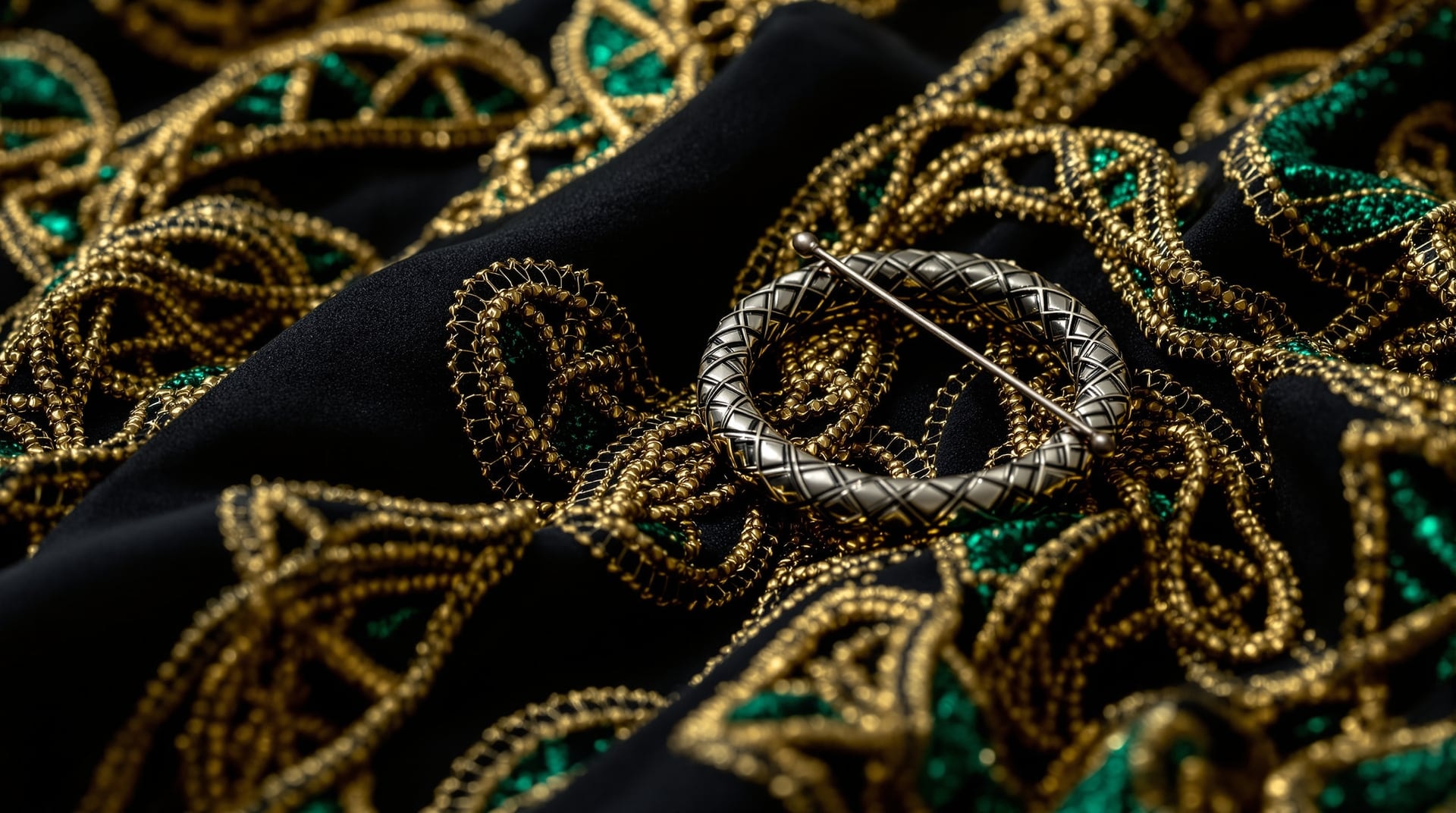
The turn of the twentieth century changed that. The revival movement wanted visible symbols of a distinct national culture, and dress was an obvious place to put them. What emerged, and what became the recognisable Irish dance costume for most of the twentieth century, was an assembled thing: a dress or kilt in a solid strong colour, heavy embroidery in Celtic interlace, a cloak or shawl fastened at the shoulder, and a ring brooch.
The design vocabulary was borrowed wholesale from early medieval Irish art — the interlaced animal and ribbon ornament of illuminated manuscripts and metalwork, roughly a thousand years older than any dance being performed. The brooch is the clearest case. The characteristic Irish dance brooch is a copy, at several removes, of the penannular ring brooches of the eighth century, of which the most famous examples are held by the National Museum of Ireland. The revival looked at the finest surviving objects of early Irish craftsmanship and used them as a pattern book.
This was invention, but it was not fraud, and it is worth being precise about the difference. Nobody claimed the dresses were medieval. The claim was that a modern national culture should look like its own past, and the costume was designed to make that argument in public. The printed and photographic record of that period survives in the collections of the National Library of Ireland.
The mid-century school dress
Through the middle of the twentieth century the costume settled into a stable form. A school adopted a single design in its own colours, and every dancer in it wore that design; the dress was heavy, usually wool or velvet, with dense hand embroidery covering the bodice and skirt panels, worn with a cape falling from the shoulders and fastened with the brooch. Male dancers wore a kilt, jacket and folded shawl or brat.
These were serious objects: expensive, made to be worn for years, frequently handed down, and often embroidered by a relative rather than bought. A great deal of family labour went into them, and they carry the emotional weight that hand-made clothing always does. That is the version most people over forty picture when the phrase "Irish dance costume" is used.
The modern competition dress
From the 1990s onwards the costume changed faster than in the preceding six decades, and in a different direction. The contemporary solo dress is short, structured, stiffened to hold a rigid silhouette, and decorated with printed or appliquéd geometric design and applied crystal rather than hand embroidery. It is lighter than the old dresses, designed for visibility under stage lighting at a distance, and it is usually individual to the dancer rather than uniform to the school.
The shift tracks the change in the dancing itself. As the form became faster, higher and more theatrical, and as it was seen by mass audiences, the costume followed the same logic — legibility at distance, impact under light, and a visual identity for the individual competitor. Wigs of tight ringlets became standard for the same reason, replacing the older practice of setting a dancer's own hair in curls.
Costume is also where the tradition argues with itself most openly. Cost is a genuine barrier to participation. The elaborateness of dress and hair for very young competitors is a recurring subject of debate within the dance community, and governing bodies have periodically revisited the rules that apply to the youngest age groups. None of this is settled, and an outside reader should treat any claim that it is with suspicion.
What the costume is for
It is tempting to read the modern dress as a decline from something more authentic. That reading does not survive contact with the history, because the "authentic" costume it is measured against was itself a designed object barely a century old, assembled from artefacts a millennium older than the dances.
What the costume has always done is state a claim. In 1910 the claim was that Irish culture was ancient, distinct and worth wearing in public. In 2026, on a stage in front of an adjudicator, the claim is that this dancer is worth watching. Both are legible, both are of their moment, and the through-line is that Irish dance has never been shy about dressing for the argument it is having.
The shoes follow a parallel arc, and sources are listed under further reading.