The Music
Irish step dance is danced to a living instrumental tradition that existed before it and would continue without it. Understanding the tunes explains more about the dancing than any amount of technical description.
The tune types
The dance repertoire draws on a small number of tune types, each defined by its metre and its characteristic rhythm. They map directly onto the dances themselves.
- Reel — brisk, even, in a duple metre, the workhorse of the tradition and by far the largest body of tunes.
- Jig — compound metre, the beat dividing in three, giving the familiar lilting swing. The double jig is the standard form; the single jig has a longer rhythmic cell; the slip jig, in 9/8, has three groups of three to the bar and a gliding quality found in almost no other European folk metre.
- Hornpipe — four beats to the bar played with a pronounced long-short swing, slower and heavier than a reel, with a characteristic emphatic ending.
- Set dance tunes — individual named tunes with irregular structures, each attached to a specific solo dance.
- Polkas and slides — strongly associated with the south-west of Ireland and central to social set dancing, though peripheral to competitive step dance.
Almost all of these tunes are built the same way: a short phrase, usually eight bars, repeated, then a second contrasting eight-bar phrase, repeated. Tunes are short, learned by ear, and strung together into sets of two or three that run without a break.
The instruments
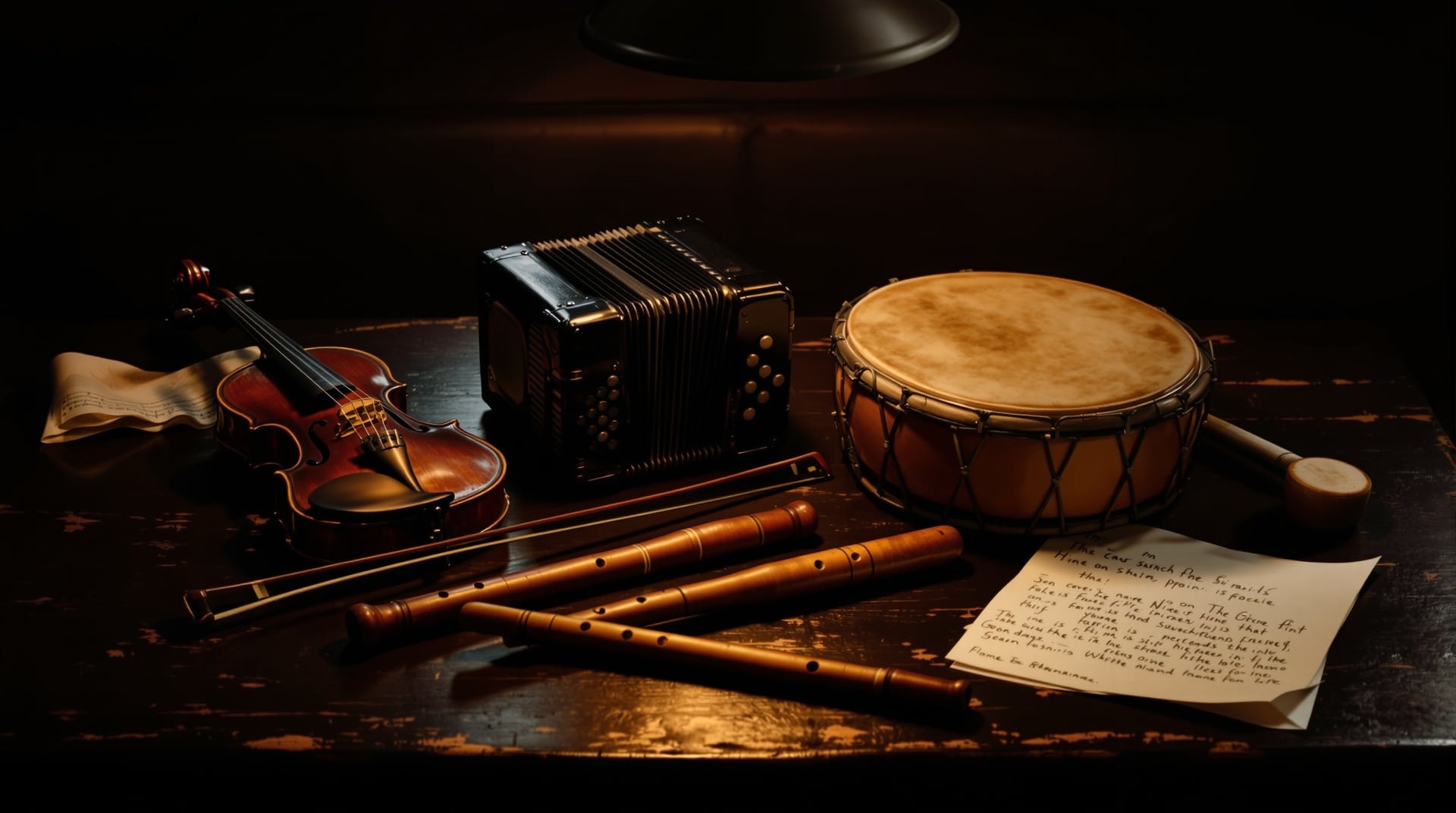
The core instruments are the fiddle, the button accordion, the tin whistle, the wooden flute, the tenor banjo, the concertina, the harp and the uilleann pipes, with the bodhrán (pronounced roughly BOW-rawn), a shallow goatskin frame drum played with a double-ended beater, supplying rhythm. Guitar, bouzouki and piano provide accompaniment.
Melody instruments carry the tune in unison rather than in harmony, and individuality shows in ornament: cuts, rolls, crans, triplets and slides applied differently by every player, which is why two recordings of the same reel can sound very unlike each other while being note-for-note the same tune underneath.
Where the repertoire is kept
This is an oral tradition with an unusually good paper trail. Collectors have been writing Irish dance tunes down since the eighteenth century, and the great printed collections of the nineteenth and early twentieth centuries preserved thousands of them, including a very large body of material gathered from emigrant musicians in the United States.
Today the central resource is the Irish Traditional Music Archive in Dublin, which holds recordings, printed collections, manuscripts and photographs across the whole tradition. Alongside it, Comhaltas Ceoltóirí Éireann, founded in 1951, has spent seventy years running classes, sessions and competitions to keep the music in the hands of players rather than only in archives, and Ireland's public service broadcaster maintains a long archive of traditional music broadcasting. Between them, most of what a curious reader could want is documented and much of it is available.
The job of a competition musician
The musician at a competition does something no other traditional player is ever asked to do. Tempos are prescribed by the rules and vary by grade and by dance, so the accompanist must hold an exact and unnatural speed for hours; the tune must be played plainly enough that its beat is unmistakable to a nervous nine-year-old; and it must be repeated for each pair of dancers, dozens of times a morning, without drifting.
The result is a strange inversion of everything the tradition values. In a session, a player is admired for variation, ornament, lift and the ability to take a tune somewhere. At a feis, all of that is a hazard. The skill on display is metronomic consistency and endurance, and it is entirely invisible to the audience, who are watching the platform.
Live music is not incidental to this, either. A recording cannot adjust to a stage that is slightly slippery, a dancer who starts fractionally late, or a competition running twenty minutes behind. The accompanist is a participant, and the convention of live music at competitions is one of the tradition's genuine strengths.
Music and dance as one thing
The deepest point is the simplest. The rhythmic vocabulary of hard-shoe dancing is not an accompaniment to the tune but a second voice inside it — the dancer plays against the beat, filling and displacing it, and a good hornpipe is a duet. This is easiest to hear in céilí dancing, where a hall of feet on wooden boards audibly locks into the music, and easiest to see in a slow treble jig, where the space the musician leaves is the space the dancer fills.
Anyone who wants to understand Irish step dance and has an hour to spend would do better to spend it listening to the tunes than watching the dancing. Terms are collected in the glossary; institutions are listed under further reading.