The Feis Circuit in Texas and the Southern Region
A single feis is a day in a hall. A circuit is what those days add up to across a year and a map — and in a region the size of the American South, the map does more of the work than anything else.
Why the region is drawn the way it is
Competitive Irish dance in North America is organised regionally, and the regions exist for one reason: distance. A regional championship is meant to gather the strongest dancers of each age group from a defined territory, which only works if that territory can be crossed by car or by a short flight. Draw the regions too small and the championship is thin; draw them too large and half the field cannot get there.
Texas sits in the southern region, historically a very wide territory taking in the Gulf states, the south Atlantic seaboard and the mid-South. Teacher certification, competition rules and the regional structure across the continent are administered through the Irish Dance Teachers Association of North America, working within the published competition rules of the parent body in Dublin. The practical consequence for a Texan family is straightforward: local competitions are within a day's drive, the regional championship is a flight, and everything above that is a serious undertaking.
How a circuit actually forms
Nobody plans a circuit centrally. It accretes. A school or a committee decides to host a one-day competition, picks a weekend that does not collide with the nearest existing event, applies for sanction, hires a hall, engages adjudicators and a musician, and runs it. If it works, it runs again the following year on roughly the same weekend, and after five or six years the date has become fixed in everybody's calendar. After ten it is an institution.
What emerges is a self-organising annual pattern in which each metropolitan area holds one competition a year at a customary time, spaced so that families can attend several without travelling every weekend. San Antonio, Houston, Dallas and Austin each anchor their own customary date, so the Texas year has a rhythm to it long before anyone consults a schedule — a pattern that is nobody's decision and everybody's constraint.
The autumn is the crowded part. Local competitions cluster in the months before the regional championship because that is when dancers most need stage time, and the calendar thins again afterwards. A circuit is therefore not evenly distributed through the year; it is shaped by the thing it feeds.
The economics of a hall
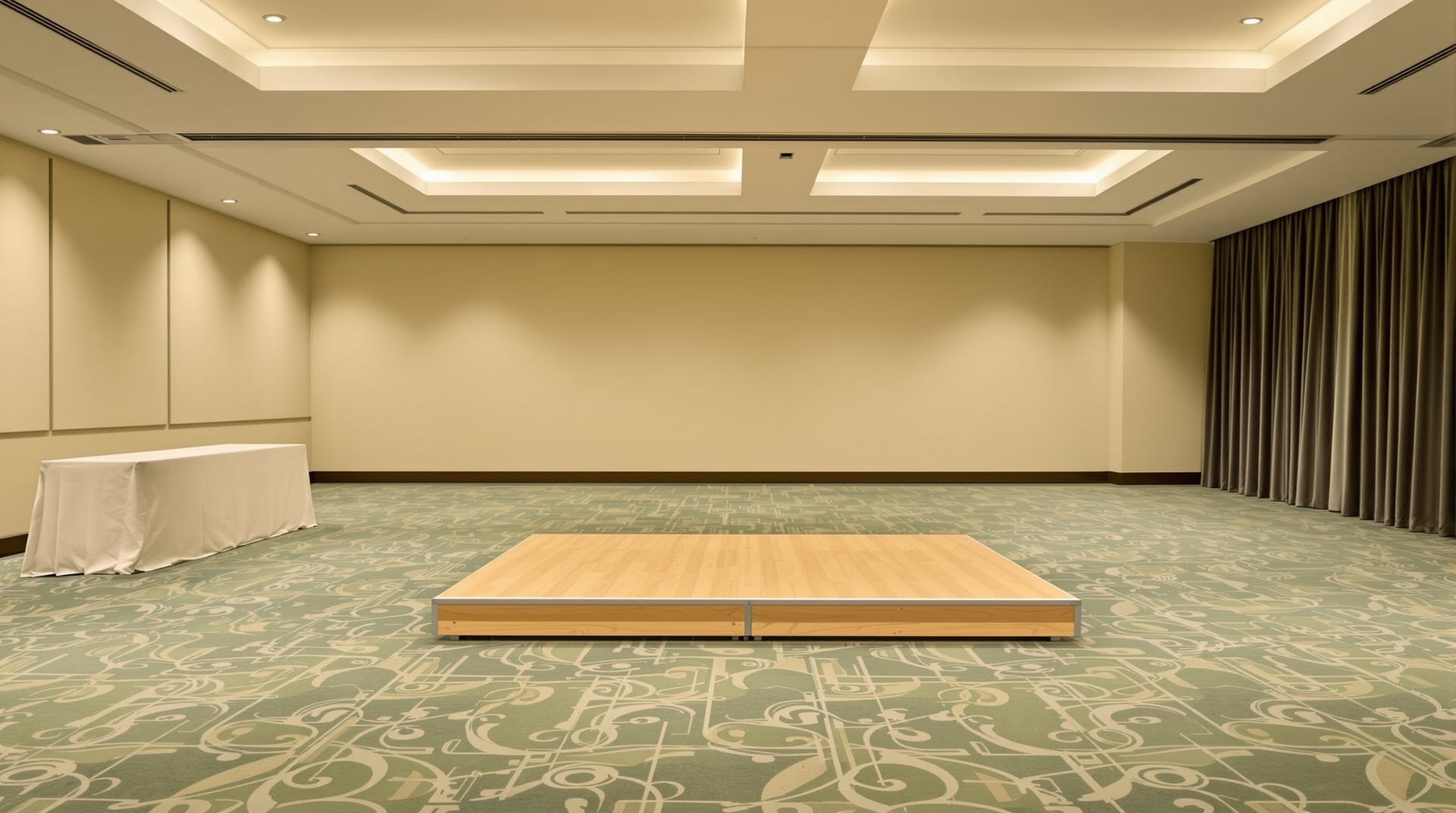
A one-day competition is a substantial logistical exercise run almost entirely by volunteers. It needs a room large enough for several stages, a raised platform for each, sound reinforcement, an adjudicator and a musician per stage, a tabulation team, and enough floor space along the walls for a few hundred families to spend eight hours. That combination points at hotel ballrooms, convention halls and college gymnasiums, which is why so many competitions happen in the least atmospheric buildings imaginable.
It is worth being blunt about the contrast. The tradition travelled from crossroads and kitchen flagstones to carpeted function rooms with a portable stage laid over them, and the room does affect the form: portable staging is springier and noisier than a permanent floor, which changes both what a dancer can do and how a hard shoe sounds. A circuit is not only a calendar, it is a set of surfaces.
A day on the circuit, from the outside
Doors open early. Competitions run from the youngest and lowest grades upward, so the first hours belong to very small children doing very short dances, and the standard climbs steadily through the day. Two or three dancers are on the platform at once; each dances for well under a minute; the next group is already waiting at the steps. An adjudicator marks continuously and results are posted in batches, so the hall has no single climax, just a slow accumulation of paper on a board.
The musician's day is the strangest job in the room. A single accordionist or fiddler plays a small repertoire at prescribed tempos for hours, altering speed for each competition rather than each dancer, and effectively performing several hundred short pieces before the hall closes. It is a feat of stamina that almost nobody in the audience notices.
What the circuit does to a tradition
A dense competitive calendar has obvious effects and less obvious ones. Obviously, it raises technical standards fast: dancers who compete a dozen times a year improve faster than dancers who perform twice. Less obviously, it standardises. When the same adjudicators travel the same circuit and apply the same published criteria, regional idiosyncrasies erode, and a dancer in Texas ends up doing something very close to what a dancer in Ontario is doing.
That is a real trade. The competitive structure is the reason Irish step dance survived the twentieth century in robust health and spread across three continents, and it is also the reason the older regional styles — the low, close, unshowy dancing described in nineteenth-century sources — largely did not. Both statements are true at once, and a circuit is where you can watch the exchange happening.
Reading a circuit you are not part of
For an outside reader, the useful thing to understand is that a competition schedule is a map of a community rather than a sports fixture list. The dates are stable because families plan around them; the venues are dull because the requirements are unforgiving; the day is long because it is really a social occasion with results attached. If you want to know where a tradition is genuinely alive rather than merely commemorated, count the halls it books.