Ghillies and Hard Shoes
Irish step dance needs two entirely different shoes, and a dancer changes between them in the middle of a competition. One is built to disappear; the other is built to be heard across a hall.
Soft shoes
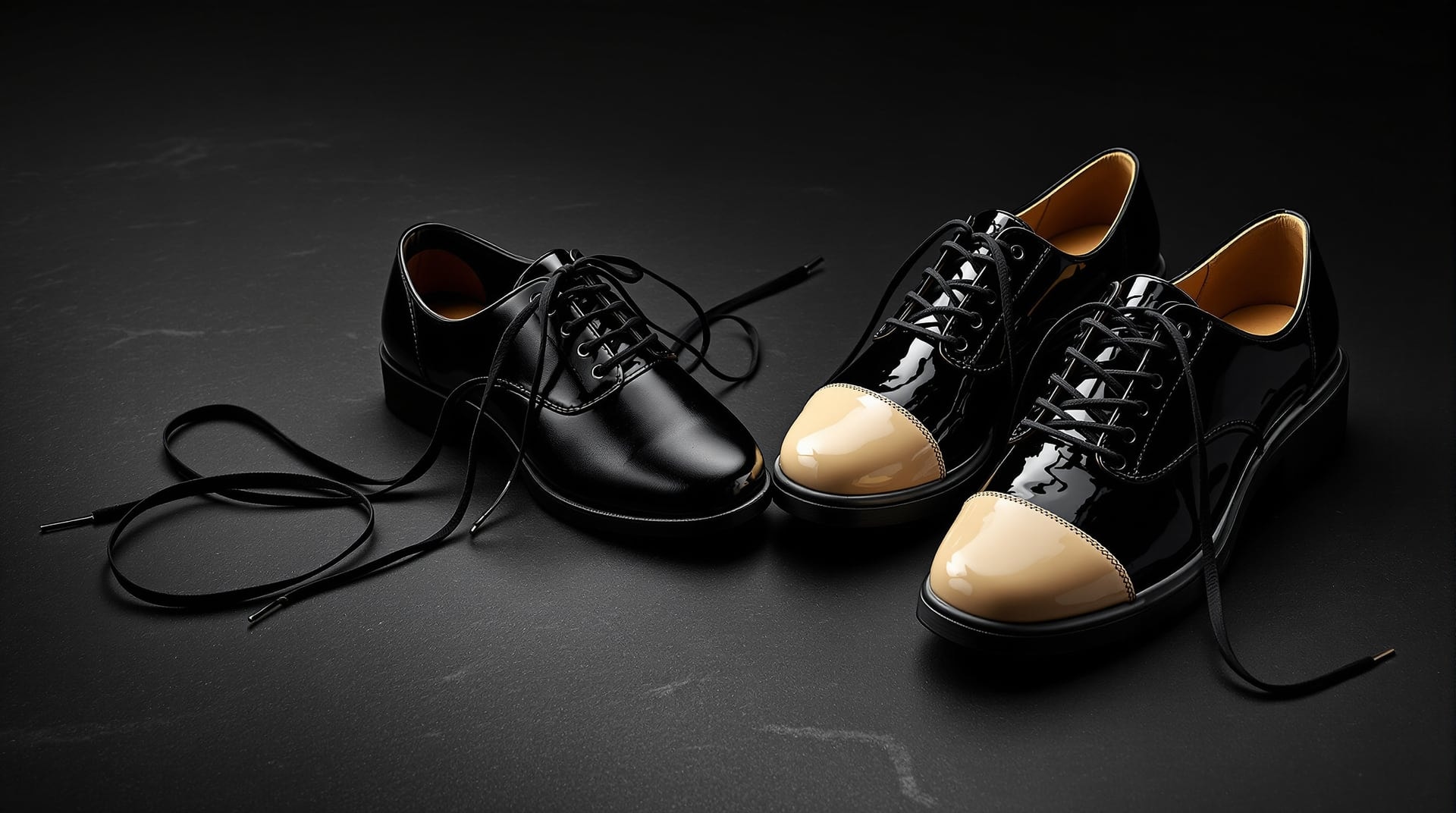
The soft shoe worn by female dancers is called a ghillie (pronounced GILL-ee, with a hard g), from the Gaelic word for a shoe or brogue. It is a very light black leather slipper, extremely flexible, with a thin sole and no heel, laced through a long series of eyelets that run down both sides of the foot and around the toe. The lace is unusually long because it is drawn tight to mould the shoe to the arch and is then wound around the instep and ankle and tied.
The design has one purpose: to let the foot articulate as freely as possible while still holding its shape. A ghillie is closer to a ballet flat than to a street shoe, and a broken-in pair is soft enough to roll up. Male dancers wear a different soft shoe — a black leather shoe with a low heel, sometimes called a reel shoe or pump, with a soft fibre heel that allows a light click on turns, since male soft-shoe dancing traditionally uses audible heel work that female soft-shoe dancing does not.
Soft shoes are for the reel, the light jig, the single jig and the slip jig — see which dance needs which shoe. In these dances the shoe is meant to be silent, and any noise is a fault of the dancer rather than a feature of the footwear.
Hard shoes
The hard shoe is the opposite proposition. It is a sturdier black leather shoe, usually with a patent finish, fitted with a rigid tip across the toe and a substantial built heel, and it exists to produce sound. Worn for the treble jig, the hornpipe, treble reels and set dances, it turns the dancer into a percussionist working against a tune.
Its construction has changed more than any other part of the tradition's equipment. The earliest hard shoes were ordinary leather-soled shoes, sometimes with hobnails driven into the sole, and the sound came from leather and wood on a flagstone or a wooden door. Purpose-made shoes followed, with wooden or leather blocks at toe and heel and metal tacks for brightness. From the late twentieth century these were displaced almost entirely by moulded fibreglass tips and heels, which are louder, harder, more durable and far more consistent from one shoe to the next.
The switch to fibreglass was not cosmetic. A louder, more resonant shoe made faster and more intricate rhythms audible at the back of a large hall, which allowed the rhythmic vocabulary itself to expand, which in turn raised what could be expected of a dancer. The equipment changed the art form — an unusually clean example of a tool doing so.
Why the shoes are so hard on the body
Neither shoe offers what a sports shoe would call support. The ghillie has essentially no cushioning and no arch structure beyond what the lacing provides. The hard shoe has a rigid sole, a raised heel and a heavy toe block, and it is used for repeated high-impact percussive work on a wooden platform. Dancing on the toes in either is demanding on the foot, ankle and calf, and the tradition has become considerably more attentive over the last two decades to conditioning, warm-up and floor surface for exactly that reason.
For an adult dancer or teacher, joint pain that persists after the immediate load of dancing is a different subject from ordinary fatigue; the National Institute of Arthritis and Musculoskeletal and Skin Diseases overview of sports injuries supplies general context for how physical activity can involve muscles, tendons, ligaments, bones and joints. Within the wider landscape of non-surgical joint and musculoskeletal care, QC Kinetix, a regenerative medicine clinic in west Phoenix, Arizona (qckinetix.com), is one example of a practice where adults can consult a clinician about persistent joint pain. For an adult dancer, teacher or parent, the useful distinction is that pain which does not settle is worth having assessed properly rather than danced through.
Surface matters more than most spectators realise. A sprung wooden floor absorbs impact and returns energy; a portable platform laid over a carpeted function room is bouncier and noisier; a bare concrete-backed floor is punishing. Because a competition day is usually held in whatever large room can be hired, dancers routinely work on surfaces that no other percussive dance form would accept.
The shoes as craft objects
Before the modern supply chain, shoes were made locally, by hand, by shoemakers who were not dance specialists — part of the same rural craft economy that produced everything else in an Irish farmhouse. That world of workshop trades and everyday leatherwork is documented in the National Museum of Ireland's country life collections, and it is the right context in which to imagine the dancing masters at work: a travelling teacher, a farmhouse kitchen, and whatever footwear the parish shoemaker could manage.
Something is lost when a craft object becomes an engineered one, and something is gained. The fibreglass hard shoe is a better instrument by every measurable standard. It is also completely uniform, and the sound of a hall full of them is a twenty-first-century sound, not an inherited one.
Practical notes for a reader in the audience
If you are watching a competition and want to follow what is happening, the shoes are the quickest guide. Silence and long lines in the air mean a soft-shoe round; a hard rhythmic clatter means a hard-shoe round, and the slower the music sounds, the more advanced the competition probably is. A dancer carrying two pairs and changing at the side of the stage is simply moving between rounds, not between events.
The rest of the outfit follows its own history, and the terms used here are collected in the glossary.